





MAIN FEATURES:
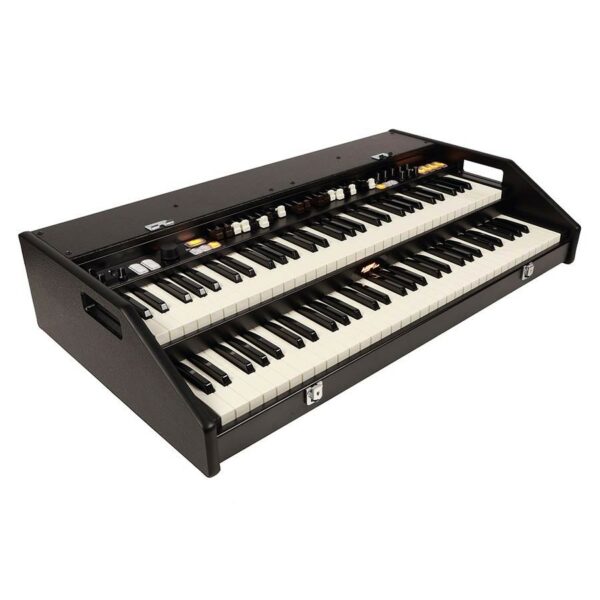
- Two-manual organ with two 61-note, 5-octave, semi-weighted, waterfall-style, velocity-sensitive keyboards
• Tonewheel organ synthesis by physical modelling
• Rotary speaker simulation
• Stereo digital reverb
• Optional external Wi-Fi antenna to connect a smartphone/tablet/PC and access the editor web app
• Online USB wired editor
• Two groups of 9 real drawbars plus 2 pedal drawbars
• Knobs for volume, drive, reverb, key click, crosstalk, percussion volume, balance, distance, bass, mid and treble
• Four knobs dedicated to tonewheel organ percussion.
• Dedicated buttons for turning
vibrato on/off
• Vibrato type button • Drawbar HOLD mode for alternative drawbar settings •
Two drawbar presets per manual with easy storage mode
• Dedicated button for rotary effect speeds
• Pedal to lower function (adds the pedalboard sound to the lower manual)
• Shift button for alternative functions (transposition, rotary bypass)
• MIDI IN and OUT connections
• USB Type B (device) for MIDI IN/OUT
• 2 USB Type A (host) for software updates and the wifi module
• Balanced audio outputs
• Headphone socket
• Expression pedal input
• Sustain pedal input
• Halfmoon or Footswitch input with dedicated selector
• AC 100-240V
SPECIFICATIONS
• Rated power: 100V AC ~ 240V AC
• Output level: +4 dBu
• Maximum headphone output load: 32 ohms
• Dimensions: 95 x 55 x 17 cm
• Weight: 21 kg
For generations, the sound of the tonewheel organ has been one of the most widely used in every genre of music, from pop to rock, R&B to jazz… but for many musicians and producers, the problem was the instrument itself: too expensive, bulky, heavy and difficult to move. The solution arrived in the 1970s, when transistor technology made it possible to build lighter, more portable organs, but without the tonewheel. Then came the revolution of the 1990s with DSP technology, and the next revolution took place in 2012, when CRUMAR introduced the Mojo organ for the first time. It was the most affordable digital reincarnation of the tonewheel monsters, yet elegant, lightweight and the most realistic. This instrument set a new standard, with a new format, a reduced set of drawbars and a completely redesigned interface, without compromising the ergonomics and playability of classic tonewheel organs. That standard is redefined once again with the new Crumar Mojo range.
The Crumar Mojo organ is now becoming a classic. New look, new DSP platform, the same exceptional sound and the same portability. Officially powered by the GSi VB3-II tonewheel emulation, also available as a virtual instrument, the new Mojo is the ultimate portable tonewheel clone organ for the most demanding musicians. Stylish, easy to use, easy to carry and, above all, it delivers a feeling of realism.
As an option, you can add an ELEVEN connector to your setup: you will then have an 11-pin output to control a vintage Leslie speaker cabinet: for any additional options (pedals, pedalboards or others), do not hesitate to contact me:






 Discover the shop
Eva Collet –
Bon piano pour debuter. Les sons sont corrects mais le haut-parleur manque un peu de puissance.