





Description:
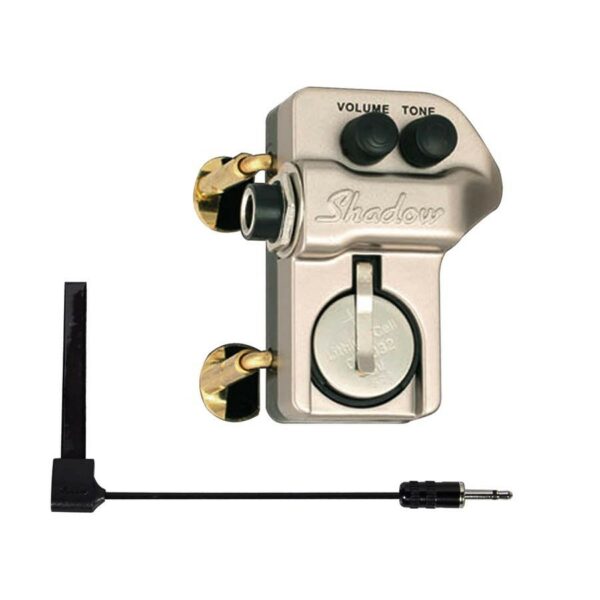
• Dual piezo pickup with jack output
• Pickup suitable for violin and viola
• Mounting suitable for all types of violin
• Simple, quick mounting, screw tightening with protection
- Faithful reproduction of the instrument’s vibrations,
- easy installation without damaging the instrument,
- total absence of hum and noise,
- ultra-sensitive Nanoflex pickup,
- volume and tone control,
- 6.35 mm jack socket,
- 3 V battery,
- very low power consumption.
A very transparent sound colour and texture, with an unrivalled dynamic response in both arco and pizzicato, are the watchwords of this violin pickup. This system delivers fine sound performance and a simple, quick installation, with no need for adjustment. Nor is there any need to turn the amp settings down again between arco and pizz. Recommended for players who use, or would like to use, wireless systems. The standard input makes connection easy. No modification of the instrument is required.
Shadow’s Nanoflex technology makes no compromise on preserving these characteristics. It is designed to reproduce the instrument’s vibrations authentically with every movement of the bow in all positions. No modification of the instrument was necessary to develop this absolutely noise-free and hum-free violin pickup system.
Nanoflex pickups do not simply pick up the vibrations of the strings like conventional under-bridge pickups. Nanoflex detects the vibrations of the strings AND of the body of the instrument simultaneously. No other pickup technology gives you such a high level of sound reproduction.
Thanks to active amplification right at the pickup and 100% shielding of the whole system, no sound will be lost and no hum will be created.
That is why the world’s best violinists use the Shadow SH 945 NFX Nanoflex violin pickup system.
The pickup mounts easily under the bridge and detects the vibrations of the bridge and the body. Control unit with volume and tone potentiometers, mounted on the chin-rest side of the violin. It has an input for the pickup, a standard 6.35 mm jack output and a 3 V battery (2032). Easy to fit, it offers a service life of one year.
Tips and tricks:
Seeing that a new generation of musicians is playing on stage today, I thought it would be useful to share with them/you some experience in the field of amplifying acoustic instruments on stage and/or in the studio
Stringed instruments.
Stringed instruments work by having the strings make the soundboard vibrate via a bridge or equivalent. The quartet and all the other stringed instruments work in the same way, so all too often, and naturally, people head for the bridge, the closest point to the strings, as with some acoustic guitar pickups that end up amplifying only the strings. Whereas when fixed at certain places on the soundboard, you pick up a little of the “wood”, which makes the sound much more acoustic and closer to your instrument. Add, in a limited proportion, the sound of an air microphone (30%) and the job is done. The air that was missing from pickups is mixed in and lets you play louder with an acoustic sound.






 Discover the shop
Verified owner Jacques R (client confirmé) –
En tant que violoniste amateur, j’avais acheté un micro PRODIPE VL21C avec un boitier BP21. Ce micro, bien que très petit, facile à installer et avec un bon son naturel, présente un très gros problème : on entend la respiration (le souffle) du violoniste autant que les cordes. A la sortie de l’ampli c’est insupportable. J’ai donc retourné le produit. Puis j’ai lorgné un moment du côté des solutions SCHERTLER qui, compte-tenu du prix, s’adressent plus à des pros. J’ai finalement acheté, sans trop savoir à quoi m’attendre, un capteur FWF Systemes MV11.
L’installation du capteur piezzo sur le chevalet a été confiée à mon luthier car il l faut élargir très soigneusement l’encoche du chevalet, du côté de la corde Sol, pour que le capteur s’y glisse en se coinçant très légèrement. Puis le boitier avec sa sortie jack se place en pinçant l’épaisseur du violon. L’ensemble capteur et boitier ne pèse que 26 grammes ce qui est très négligeable.
On peut mettre en place et démonter l’ensemble très facilement sans abimer ni le verni ni l’ébénisterie pour passer d’un jeu avec ou sans amplification. Pas de risque pour le violon.
J’utilise un petit transmetteur HF que je plugge directement dans le jack 6,35mm du boiter. L’ensemble micro + HF fait 67g et ne se ressent quasiment pas par rapport au 560g du violon équipé de son épaulière. Ceci permet de conserver sa sensation de tenue du violon et d’avoir la grande liberté de pouvoir jouer amplifié sans aucun fil à patte. J’utilise un ampli pour guitare électro-acoustique avec, en entrée, le récepteur HF. Le son obtenu est vraiment proche du son naturel du violon, ce qui est remarquable pour un capteur piezzo, avec la sérénité de jouer en absence totale de larsen. La sensibilité du jeu du violoniste est totalement reproduite dans l’ampli. Le réglage de volume sur le boitier du MV11 est bien pratique pour faire un petit ajustement de dernière minute sans avoir à accéder à l’ampli.
J’utilise ce capteur depuis 6 mois et je le recommande vraiment à tous ceux qui veulent amplifier leur violon, sans risquer le larsen, tout en conservant un son naturel (surprenant pour un capteur piezzo), pour un prix extrêmement raisonnable.
Sébastien Petit –
Je suis musicien professionnel et ce micro répond parfaitement à mes exigences. Bravo.
Véronique Clément –
Installation facile et résultat bluffant. Le son est clair et sans souffle. Excellent rapport qualité-prix.
AMP –
test