



How to change your guitar strings: a complete step-by-step tutorial

Why change your strings regularly?
Worn guitar strings gradually lose their brightness, their intonation and their tuning stability. Even if they do not break, they oxidise through contact with sweat and humidity, and build up residue that stifles the harmonics. A simple string change can bring your instrument back to life and greatly improve your enjoyment of playing.
Discover our complete catalogue of guitar strings and find the ones that suit your instrument and your style.
When should you change your strings?
There is no universal rule, but here are some reliable indicators. If your strings show signs of discolouration, if they struggle to stay in tune, if the sound seems dull and lifeless, or if you feel irregularities under your fingers, it is time to replace them. On average, a guitarist who plays every day should change strings every 2 to 4 weeks; an occasional player, every 6 to 8 weeks.
How to change the strings on an acoustic guitar
Step 1: Remove the old strings
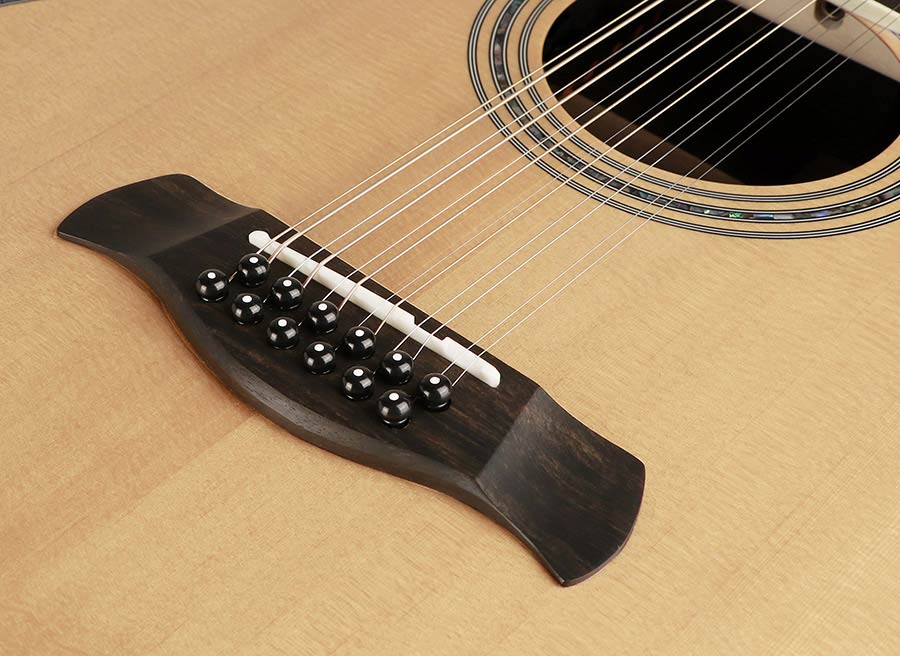
Slacken each string by turning the tuning machine, then remove it from the tuning machine and the bridge. On an acoustic guitar, the strings are held at the bridge by pins (bridge pins), which have to be removed carefully. Take the opportunity to clean the fingerboard with a dry cloth and, if necessary, apply a little lemon oil made for fingerboards.
Step 2: Fit the new strings
Insert the ball end of the string into the hole in the bridge, then put the pin back while pulling the string slightly upwards to make sure it is properly seated. Pass the other end through the hole in the tuning machine and start winding, making sure the coils run neatly from the top to the bottom of the post.
Step 3: Tuning
Tune each string with a reliable electronic tuner. New strings stretch quickly, so you will need to retune several times during the first hours of playing. A tip: gently stretch each string by lifting it slightly along its whole length to speed up stabilisation.
How to change the strings on a classical guitar
The process is different for a nylon-string classical guitar. At the bridge, the string goes through the hole and is secured with a specific knot (generally, the end is passed under the string and then locked under the coils). At the tuning machines, the strings are wound in the same way as on an acoustic guitar, but because nylon strings are smoother, it is recommended to make an extra locking turn to prevent slipping.
Choosing your strings well
The gauge
The gauge refers to the thickness of the strings. A light gauge (extra-light or light) is easier to play and suits beginners or fingerpicking. A medium gauge offers a good balance between comfort and volume. A heavy gauge produces a powerful, full sound, favoured for energetic strumming and open tuning.
The material
80/20 bronze strings offer a bright, crystalline sound, ideal for picking and solo passages. Phosphor bronze strings produce a slightly warmer sound and last longer thanks to the corrosion resistance of phosphorus. For classical guitars, standard nylon strings remain the benchmark.
What about other stringed instruments?
The same care applies to other instruments. We also offer violin strings, cello strings and double bass strings. Each family of instruments has its own specifics when it comes to gauge, material and fitting technique.
Conclusion
Changing your strings is a simple job that has an enormous impact on sound and playing comfort. Get into the habit of doing it regularly and experiment with different brands and gauges to find your ideal combination. Find our whole range of strings for instruments in our shop.




 Discover the shop