

Learning to play the guitar on your own: 3 questions to ask yourself

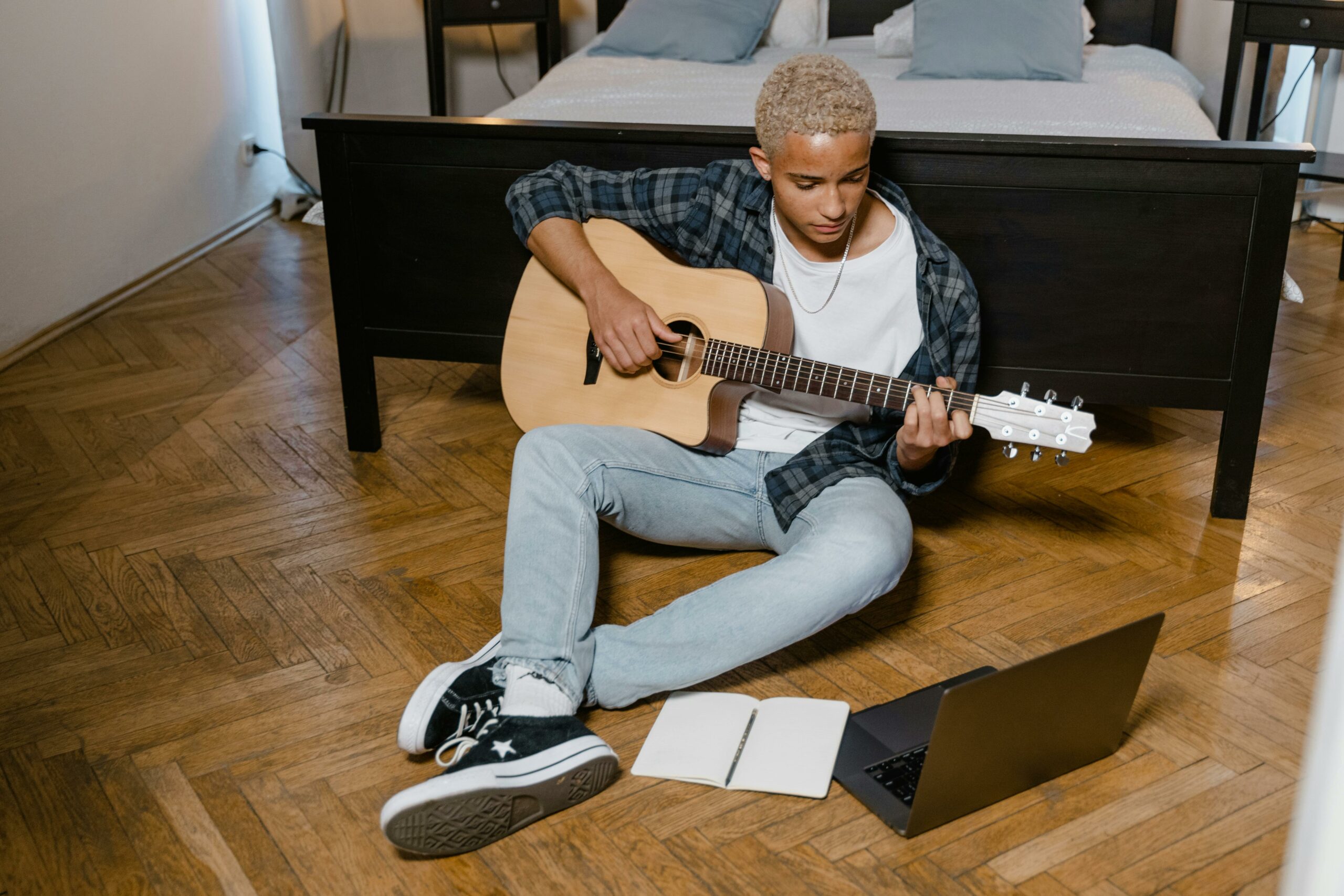
Learning the guitar on your own can be a real challenge, whatever age you start at. Do music theory and sheet music scare you? Don't worry! By mastering a few basic chords, you will easily read tabs and soon be enjoying yourself. There are many learning methods, and getting started on this instrument as a self-taught player is perfectly possible. Ask yourself the right questions to build solid knowledge.
1. Why do I want to learn the guitar on my own?
The question may seem surprising, but it is a crucial one! It is always easier to take guitar lessons with a teacher. However, there are many reasons for learning an instrument independently: lack of funds, a schedule that is too busy or keeps changing, a personal challenge, living a long way from a music school, a search for flexibility…
Whatever the case, set yourself clear and precise goals (short or medium term) to keep up your motivation, which remains a major factor in this kind of project. They will help you keep up constructive momentum.
Even when learning on your own, do not forget to:
- Schedule a weekly practice session
- Play regularly
- Make sure you have a peaceful space for your exercises
- Stay motivated
- Still talk to beginners or more experienced players
It is very important to acquire good habits from the start and to stay vigilant. You are embarking on a solitary path and have no teacher to correct you straight away.
2. What are the advantages of learning the guitar on your own?
Thanks to the internet and social media, there can be many advantages. By practising solo, you have several learning methods at your disposal, so make the most of them!
Plenty of resources
Remotely, you have many ways of multiplying your sources for learning to play the guitar for free:
- Tutorials/videos: easy to access, they often come with tabs or practical exercises.
- Apps: some feature sound recognition, so you can track your progress.
- Articles/blogs: they will give you useful tips.
- Communities/social media: being part of a community can help you put questions to people more expert than you.
Different styles of music
You have time to try out several musical styles and learn the song you like. French music, film music, rock, folk, etc. However, be careful not to overestimate your abilities. Opt instead for tunes that are easy to play or suitable for beginners, and repeat them. You thus build up a personal repertoire that makes you want to carry on and share.
Another interesting advantage: you can practise singing along to your favourite tune. Accompanying your playing with singing can be extremely enjoyable!
A wide choice of brands
You also have the chance to find out about several different instruments. Classical, acoustic, electric: the choice is huge. There are even 7-string guitars such as the Salvador Cortez Concert Series CS607. The latter is quite rare but you will find it on our site.
In any case, the classical guitar is probably the most suitable. Nylon strings are gentler on the fingers and you can find an excellently made instrument on a controlled budget.
Many entry-level guitars offer very good value for money. The Salvador Cortez CC-10 guitar and the Solid Top Artist Series CC-15 are very good products for beginners. You can resell them before moving up a range with, for example, the Sonata S also from Salvador Cortez. The best thing, of course, is to be able to try the instrument. Sound, hold, feel: several criteria come into play.
3. How long does it take to learn to play the guitar on your own?
There is no precise answer. Keep in mind that the worst mistake you can make is to rush the stages!
The guitar chords to learn first
It is always advisable to learn the eight basic chords (5 major and 3 minor). Not only will they motivate you when you manage to make them ring out in harmony, but they are also the chords most often played by all guitarists! Do not launch into barre chords or other more complicated chords: they can quickly discourage you.
Link your chords together and keep the rhythm
Next, try to change between these chords while varying very simple rhythms, such as a 4-beat or 2-beat pattern, for example. Do not be in a hurry: play slowly and try to position your fingers properly. The aim is to make the chord ring out well. This is how you work on your dexterity and enjoy your playing more and more. Isn't that the goal?
Regular practice
No surprise there: the more regularly you play, the faster you progress. Take it slowly and do not get discouraged! The guitar is not an easy instrument. Unlike a digital piano, for example, the note you play will not be pleasant to hear straight away.
In conclusion, you have the chance to progress at your own pace according to your availability, while preserving your family and professional life. You can personalise and vary your learning methods. In any case, enjoy yourself!
Do not hesitate to visit our shop to compare models or to contact us for more information.


 Discover the shop