

Resonator guitar: the features you need to know about


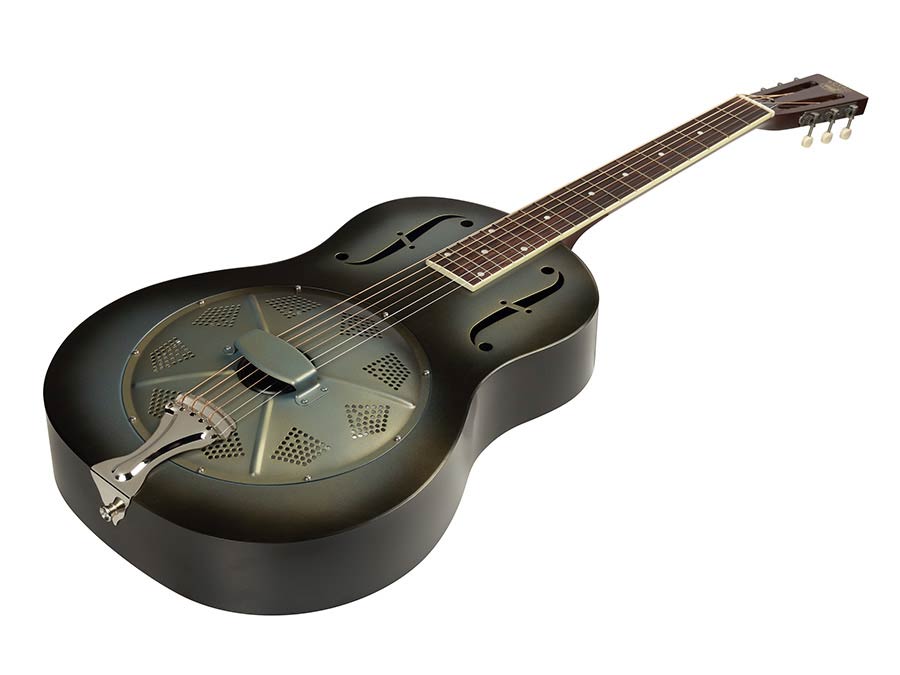
ROYALL PONY BOY Resonator Guitar
Do you have in mind the guitar from the famous “Money for Nothing” by Dire Straits ? It was a resonator guitar! Many blues players used this type of instrument to give their music powerful harmonies and a wide variety of playing techniques. The resonance provided by its wooden body or its metal body gives it a unique acoustic amplification. Dive into the fascinating world of this instrument!
What is a resonator guitar?
It belongs to the family of acoustic guitars. These traditionally have a wooden soundbox to amplify the sounds and chords produced by the strings. Resonator guitars, for their part, have metal cones to intensify the music played. The sounds produced are then more powerful.
The origins of the resonator guitar
A little history! It all begins with the Dopyera brothers, originally from Slovakia, who in the 1920s were already thinking about how to increase the volume of a guitar. The aim? To have an instrument able to compete with the volume of brass instruments or to cut through the deafening noise of the crowd. With partners, they first created the brand National under which they initially sold banjos.
The first step came in 1926 with the creation of a guitar amplified without electricity. With a metal body and neck and three stacked metal cones, the brothers had invented the first resonator guitar! It was immediately appreciated by players of blues, country music, bluegrass and even Hawaiian music.
Following a disagreement with their partners, the family founded the Dobro company (for DOpyera BROthers) in 1928, which would buy the National brand a few years later.
The 3 types of resonator
A guitar's resonance is usually provided by the wood, which amplifies the sound. Resonator guitars use metal cones to obtain a tone that offers a unique musical experience. There are 3 types.
The tricone
The tricone offers musicians incomparable resonance. The 3 cones produce a rich, deep harmony.
The Royall TriCone DLT12/DSB Resonator is a model of its kind, with its vintage machine heads and its mahogany body.
Demonstration here.
The single cone
 The single-cone resonator guitar, also known as the “biscuit”, delivers a punchier sound that will appeal to blues players who use a bottleneck. Do you remember the cover of Dire Straits' “Money for Nothing”? The instrument featured was a Royall Pony Boy PB12/ANI Resonator, ideal for guitarists looking for an exceptional instrument.
Demonstration here.
The inverted single cone
Known as the “spider”, it is perfectly suited to gentler music such as ballads or fingerpicking. The ROYALL Single Cone Spider Resonator is the ideal instrument for this kind of playing. The 14-fret neck makes it easier to reach the upper positions. Its mahogany neck makes it playable with the fingers as well as with a slide. The distinctive sound is often appreciated by bluegrass and country performers.
Demonstration here.
Playing techniques for this instrument
Slide guitar
The slide (gliding) technique is a practice well known to blues players. They slide a bottleneck along the neck to produce a very distinctive intonation. It can of course be used on acoustic or electric guitars, but resonator guitars are by far the most popular for it.
Fingerpicking
Also well suited to blues and country music, fingerpicking is a style often played on resonator guitars. The strings are plucked with the fingers. This technique, which comes almost naturally, is commonly known as arpeggio playing.
Alternative tunings on a resonator guitar
You can perfectly well tune your guitar in the traditional way (E-A-D-G-B-E). But if you practise the techniques mentioned above, watch out for tunings, which may differ. The most common are Open G (D-G-D-G-B-D) and Open D.
Types of music
Blues
It needs no introduction! With so many well-known musical riffs, blues is a perfect match for a resonator! The amplified sounds, the fingerpicking and slide guitar methods (see above): the whole of blues lends itself wonderfully to playing this type of guitar.
Bluegrass
Alongside blues, bluegrass has a fast rhythm. This style of music was brought to the fore by Hank Williams (who died prematurely at 29) and by Bill Monroe, among others. The instrument can also cover the vocal harmonies, which are sung in 3 or 4 parts.
Hawaiian music
Resonator guitars played an important role in Hawaiian music. By laying their instrument on their lap, musicians made the most of what resonator guitars can do.
A few features of resonator guitars
Just like our article asking how to choose your first acoustic guitar, many details come into play for a resonator guitar. It all depends on the style you want to play or the techniques you want to try. Also remember to choose an instrument you like and that fits your budget. There are many criteria to consider when making your choice.
Wooden or metal body
Wood will charm those looking for a warmer sound. It will appeal more to country fans. The Royall Tri Cone 12-Fret KOA Resonator with under-saddle pickup is perfect for this.
Metal can be heavier and more complicated to set up, but it will please blues aficionados.
Square or round neck
Square necks are generally wider and are designed to be laid flat on the lap, like a lap steel guitar. The strings sit higher above the neck and frets, so that a bottleneck can be slid along them. To see a demonstration, watch the video at the bottom of the page for the ROYALL Tampa Square Resonator.
Round necks, on the other hand, are suited to conventional playing.
Alongside Dobro and National, Royall is a brand you can safely count on. You will find many ROYALL Resonator models in our shop.
Amplifying a resonator guitar
Even though the resonator guitar is acoustically powerful, you sometimes have to amplify it on stage. An instrument pickup then becomes necessary. Contact pickups are particularly suitable: they pick up the vibrations of the cone without requiring the slightest modification to the instrument, which matters on a metal-bodied guitar. Paired with an acoustic amp, they preserve the metallic grain of the instrument where a magnetic pickup would flatten it.
Care and strings
A resonator guitar is looked after like a standard guitar, with particular attention paid to the cone and the coverplate. Clean the metal parts regularly to prevent oxidation, especially after an outdoor gig. As for strings, steel is generally used in a medium to heavy gauge: the tension is what loads the cone and gives it its volume. A gauge that is too light produces a hollow sound with no projection.
Contact us for more information on this subject.


 Discover the shop